
 Identification
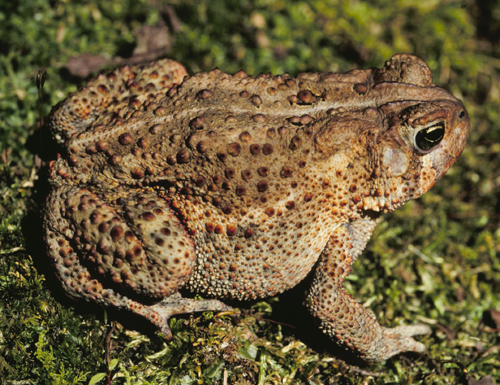
They are short, stocky toads that are variable in color; generally tan, brown, reddish brown, gray or olive, and have the ability to darken in color depending on their environment. Dark spots on the back encircle one or two warty bumps, and enlarged warts exist below the knee on the back legs. Some specimens have a light colored line that runs down the back. The noticeable lump that exists on the head behind the eyes is a parotoid gland that secretes a foul chemical to fend off predators. The underside of the toad is light, generally whitish or yellowish with some dark spotting, especially around the chest. Adults grow to around 2-3.5 inches in length. The call of the American Toad is a fast, high-pitch trill that can last up to 30 seconds. Click here to hear the call from Indiana DNR.
Distribution and Status
The American Toad survives quite well in the Midwest and is abundant in all eight states. It is commonly found in Central and Eastern Indiana, however, it is rarely found in lower Wabash county.
Ecology
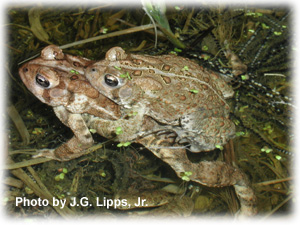
The American Toad can be found in a wide variety of areas including urban areas, such as back yards, agricultural areas; or more pristine areas like open woodlands, prairies, meadows, marshes. The major habitat requirement for this toad is a body of water nearby for breeding. American Toads can often be found in moist hiding areas, such as leaf litter, as they wait to ambush their prey and hide from predators. Prey consists of a variety of insects and other invertebrates, and these toads have been known to eat anything they can stuff into their mouths.
Bruce Kingsbury, Director
Center for Reptile and Amphibian Conservation and Management
Science Building
Indiana-Purdue University
2101 East Coliseum Blvd.
Fort Wayne, IN 46805-1499